Anthropic has been publishing quarterly reports on how people actually use Claude at work — not surveys about how they might use AI someday, but anonymized data from millions of real conversations. The findings are more specific and more uncomfortable than most AI-and-jobs coverage suggests.
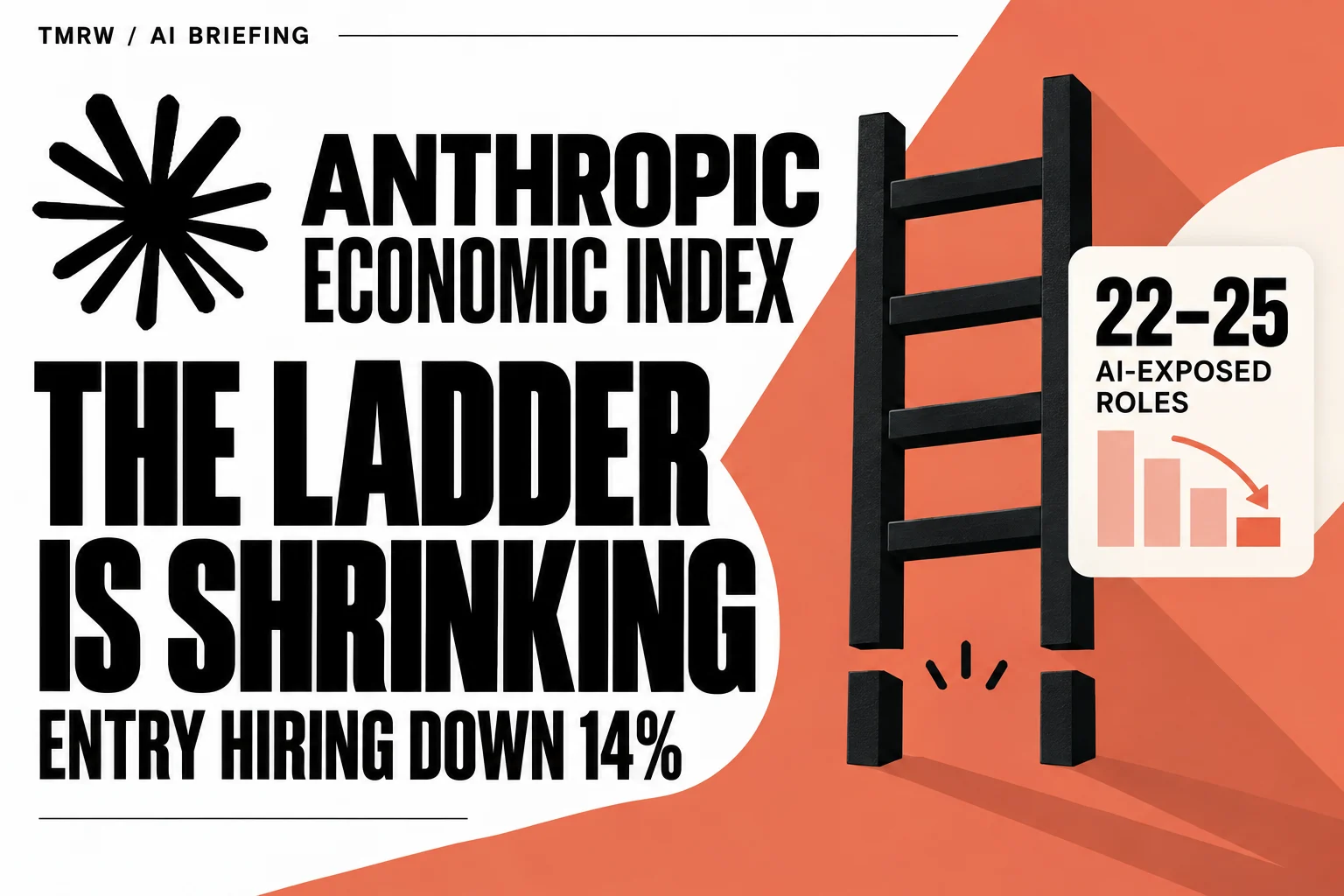
The headline number: roughly 49% of occupations now show AI being used for at least a quarter of their associated tasks, up from 36% a year earlier. But the number that should hold your attention is a different one: hiring of workers aged 22 to 25 in AI-exposed occupations has dropped by approximately 14% compared to unexposed sectors since late 2022.
Who is actually using AI at work
The data paints a specific portrait. The average Claude user earns around $47.90 per hour — well above the national average of $37.30. They are disproportionately college-educated, white-collar, and working in mid-to-high-wage roles. Computer and mathematical occupations account for 37.2% of all Claude conversations despite representing only 3.4% of the U.S. workforce. Arts, design, and media follow at 10.3%. Physical-labor sectors — farming, construction, maintenance — register at 0.1%.
This is not a story about AI replacing factory workers. It is a story about AI reshaping desk work, and the people most affected are the ones who already earn above-median wages.
Augmentation is winning — for now
Anthropic's data shows that 57% of AI-assisted tasks involve augmentation — the human stays in the loop, using AI to iterate, learn, or validate — while 43% involve direct automation, where AI performs the task outright. That split matters because augmentation tends to make existing workers more productive, while automation tends to eliminate the need for a worker at all.
But the ratio is shifting. Coders and developers are migrating from the conversational Claude.ai interface to the API, where workflows follow more rigid rules and require less human guidance. Computer and mathematical tasks on the API increased 14% over six months while dropping 18% on the consumer web product. API usage is, by design, less collaborative. It is closer to a machine doing the work.
The top ten tasks on Claude.ai now represent 19% of traffic, down from 24% six months earlier. Usage is diversifying — more occupations, more task types, more depth. That is what adoption looks like when it moves past early adopters.
The ladder problem
The 14% hiring slowdown for 22-to-25-year-olds is not about mass layoffs. Anthropic's own researchers call the result "just barely statistically significant" and acknowledge alternative explanations. No systematic increase in unemployment has appeared for workers in AI-exposed roles.
But the mechanism matters more than the magnitude. Senior workers — older, higher-paid, more experienced — are using AI to augment their own productivity. They write faster, research faster, produce more. The work that used to be delegated to a junior hire — the first draft, the data pull, the formatting job — is increasingly done by the senior worker's AI assistant. The role is not eliminated. It is absorbed.
The result is what some researchers call pulling up the ladder: established workers keep their positions and become more productive, while the entry-level roles that would train their replacements quietly stop being filled. The BLS projects that every 10-point increase in AI task coverage correlates with a 0.6 percentage-point lower employment growth forecast through 2034.
That is a slow effect. It will not make headlines the way a layoff announcement does. But a generation that cannot get its first job in an exposed field will eventually show up in every economic indicator that matters.
What to do with this
If you are mid-career and working in a desk job, the data says you are probably fine for now. AI is making you more productive, not replacing you. The smart move is to learn the tools well enough that you are in the 57% augmentation category rather than the 43% automation category. Experienced Claude users achieve 10% higher success rates than newcomers — fluency compounds.
If you are early-career or about to enter the workforce, the picture is less clear. The roles most exposed to AI — customer service, data entry, sales development, market research — are also the roles that have traditionally served as entry points. When those positions shrink, the question is not whether you can use AI. It is whether you can find the job that teaches you everything AI cannot do: judgment, relationships, and the context that makes someone's work irreplaceable rather than automatable.
Anthropic's index does not predict the future. It measures the present. And the present says the impact is real, uneven, and mostly invisible to the people it has not reached yet.