Cover: AI-generated editorial composition by TMRW; figure reported by OpenAI. Source material.
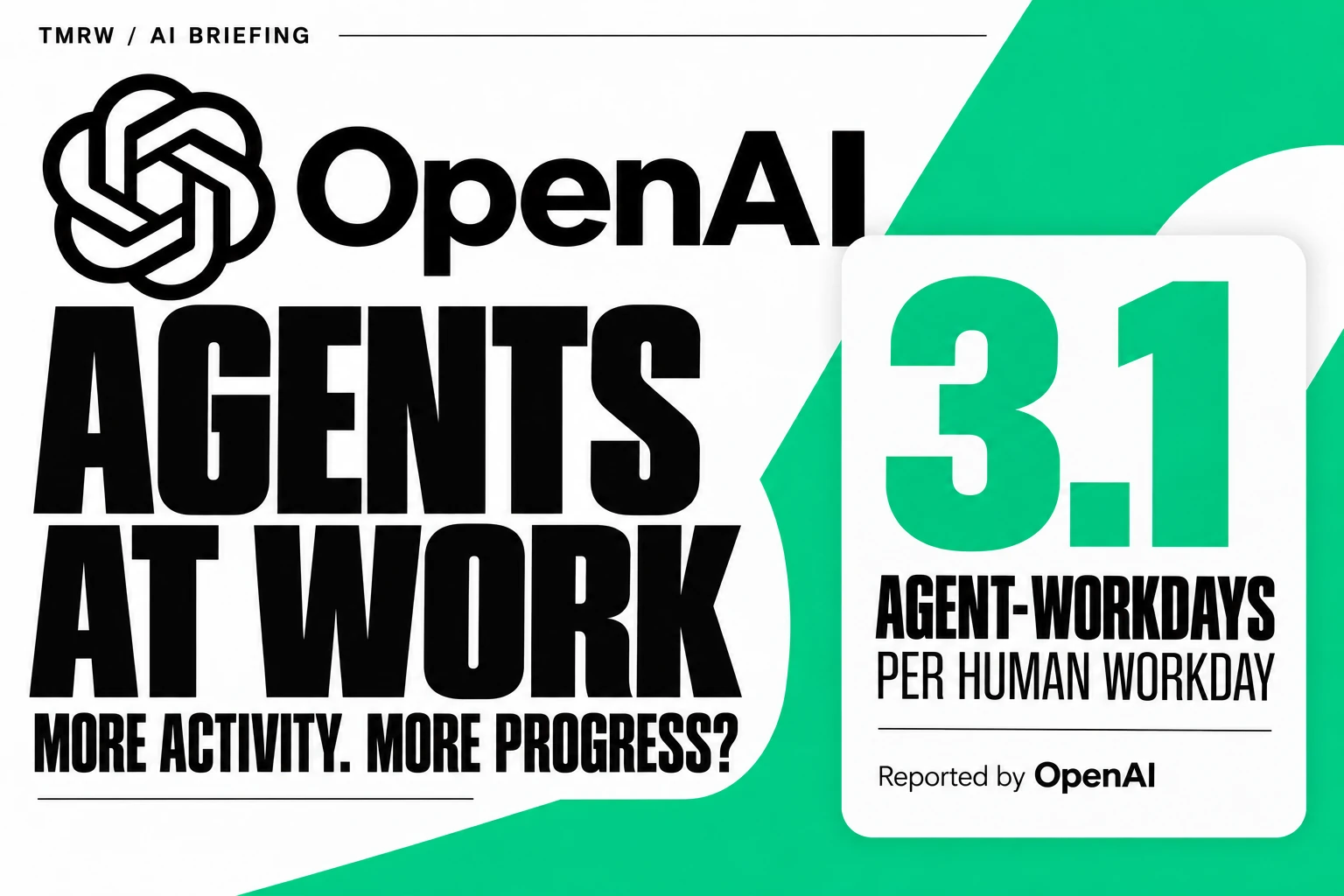
OpenAI says its research organization now uses 3.1 agent-workdays for every human workday. The number, published in its September 6 research update, is a striking measure of how much work runs through coding agents. It is not a measurement that research has become 3.1 times faster.
That distinction matters to anyone deciding how much to spend on agents. Buying more execution capacity is straightforward. Establishing which additional work was useful is harder.
What the lab actually measured
OpenAI reports rising agent use, more experiments, and continued human responsibility for priorities and judgments. It also says more than half of successful tasks estimated at four to eight hours involved at least one human intervention. The account warns that activity measures do not translate directly into overall research progress, and notes that available compute grew too.
These qualifications belong beside the headline. Runtime is an input. A successful experiment, a useful negative result or a validated improvement is an output. The relationship between them is precisely what an organization needs to discover; it cannot be assumed from the size of the first number.
Measure the entire job
The lab uses Epoch AI's research-work taxonomy, which separates decisions, design, implementation, execution, analysis and communication. That offers a more useful way to think about adoption than counting conversations with a model. Work can speed up at one stage while accumulating at the next.
Consider a hypothetical team that can now launch twenty experiments in the time it previously launched five. If one researcher still has to inspect every result, the new constraint may be interpretation. If the extra runs test poorly chosen ideas, their completion rate says little about progress. If they identify a dead end earlier, the benefit may be real even when no new feature ships.
For a small team, we would start with a record of one recurring job: elapsed time to an accepted result, review time, corrections and execution cost. Compare similar work over several runs. Keep failed attempts in the record. Otherwise the apparently efficient workflow may simply have moved its expensive steps out of the measurement.
A customer result provides another lens
In a separate September 8 OpenAI customer case study, 1Password reports a 20.9% productivity improvement among its Codex cohort and a 10.9% reduction in median pull-request cycle time. Those figures describe a different organization and different measures; they cannot be directly compared with agent runtime inside a research lab. The case study is vendor-published, rather than an independent trial.
Its usefulness is in naming outcomes that a software team can recognize. A shorter review-and-merge cycle gets closer to delivered work than token consumption does. Even then, a reader should ask how productivity was defined, how the cohort was selected, and whether quality stayed consistent.
Our reading of this week's reporting is that agents are expanding the amount of work a person can attempt. The next management problem is choosing and validating that work. Budget for the whole loop, including the person who must decide whether the result deserves to survive.