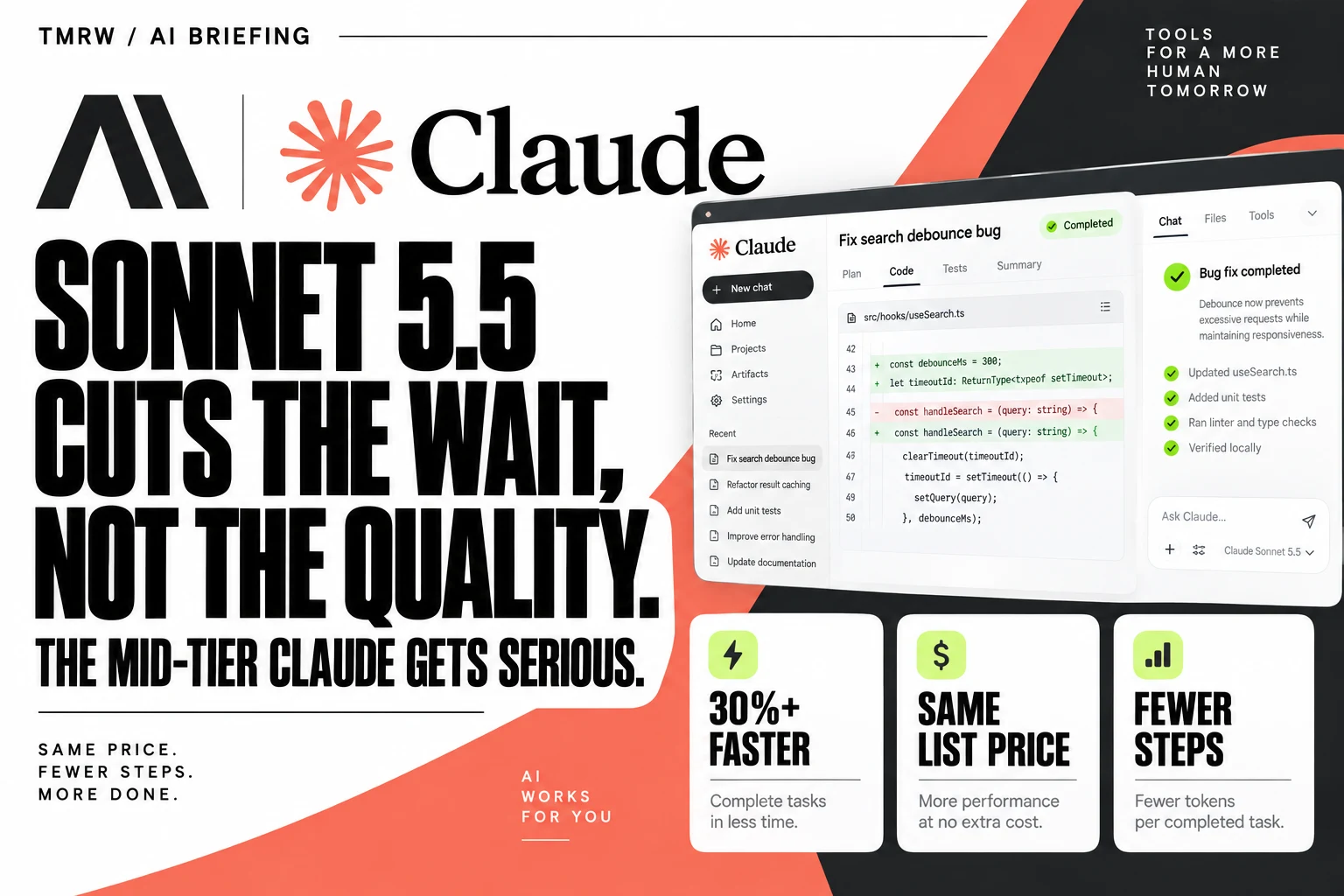
Cover: AI-generated editorial composition by TMRW, based on Anthropic’s Sonnet 5.5 release.
Claude Sonnet 5.5 keeps the same list price as Sonnet 5—$2 per million input tokens and $10 per million output tokens—but Anthropic says it finishes typical tasks with fewer tokens and runs more than 30 percent faster. The release is aimed at everyday coding, documents, slides, spreadsheets, and other well-scoped work.
The practical question is whether Sonnet can take enough work from Opus without pushing the repair bill onto a human reviewer.
The benchmark jump needs context
Anthropic reports 70.6 percent on Terminal-Bench 4.0, up from 10.3 percent for Sonnet 5. It also reports 55.5 percent on CursorBench, within roughly two points of Opus 5.5. On FrontierCode, which measures whether an agent’s code changes would be merged, Sonnet 5.5 scores 46.2 percent at max effort; Opus 5.5 remains higher.
Those numbers do not make Sonnet a cheaper Opus in every setting. Anthropic says Opus remains clearly stronger on open-ended work requiring sustained judgment. It also notes that Sonnet at high effort can approach Opus performance at a similar cost, erasing the reason to choose the smaller model.
Cost per task matters more than token price
The price card did not change. Anthropic’s savings claim comes from completing work in fewer steps and output tokens. At low or medium effort, the company says Sonnet 5.5 beats Sonnet 5’s best result on several evaluations for about one tenth of the cost per task.
That is testable. Take fifty resolved bugs or support cases and replay them with the old and new model. Count accepted completions, tool errors, clarifying questions, total tokens, latency, and reviewer minutes. A model that uses fewer tokens but makes one extra wrong change can still cost more.
A simple routing rule
Use Sonnet for tasks whose boundaries can fit in a checklist: fix this bug and pass these tests; turn these notes into this template; classify this ticket under these policies. Escalate to Opus when the model must decide what problem to solve, reconcile weak evidence, or coordinate a large change across systems.
Anthropic also added stronger cyber safeguards because Sonnet 5.5’s capabilities are now comparable to the previous Opus tier. Routine development should be unaffected, but security teams should test legitimate workflows that resemble exploit research before migrating.
Sonnet 5.5 is interesting because the middle tier is becoming good enough to own real work. The useful upgrade is not a higher score; it is a routing policy that spends Opus-level attention only where judgment earns it.