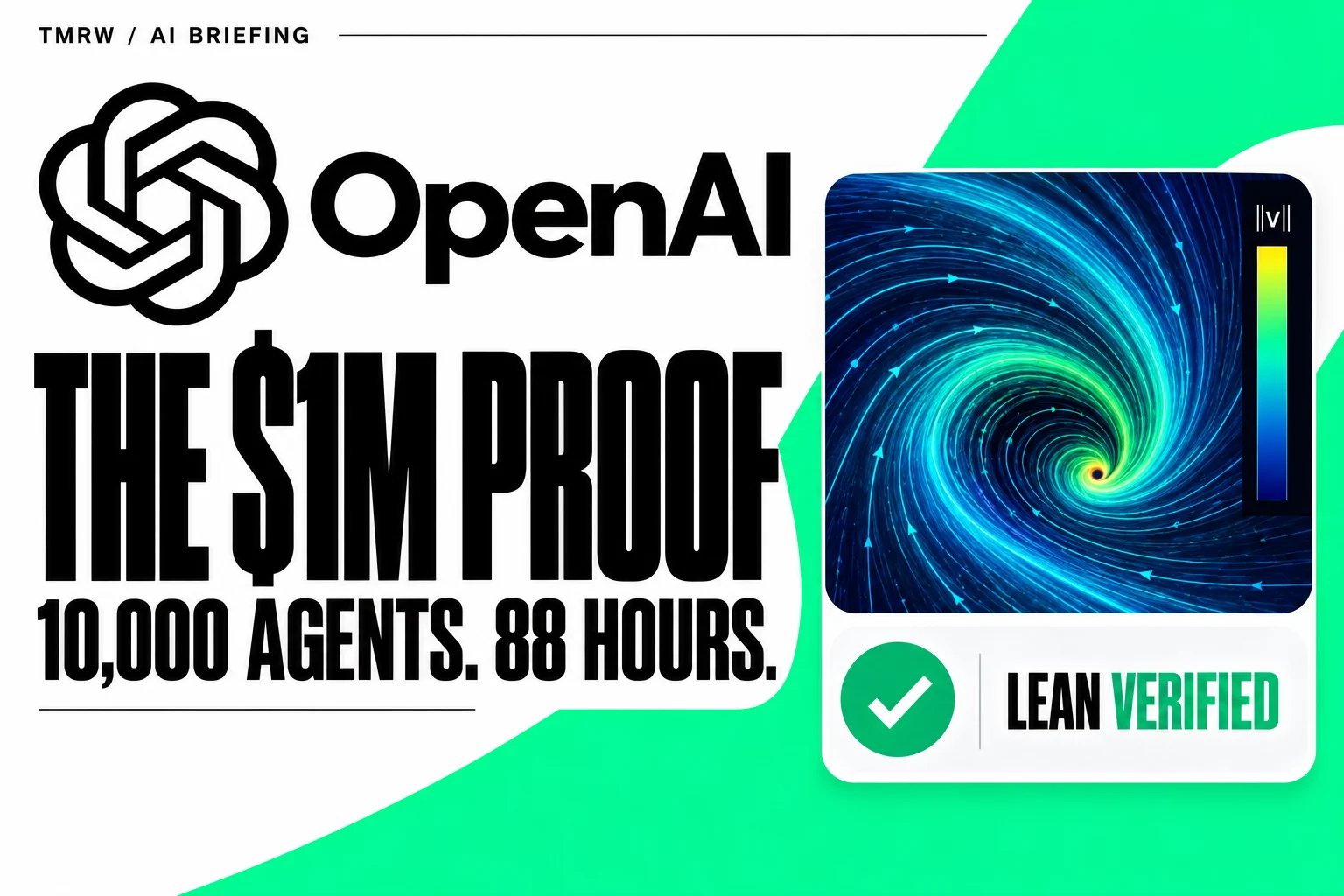
On September 8, OpenAI announced that a swarm of roughly 10,000 AI agents, running an unreleased model for 88 hours, had proved that the three-dimensional Navier-Stokes equations can develop singularities — points where fluid velocity blows up to infinity under smooth conditions. That resolves one of the six remaining Millennium Prize Problems, each worth $1 million from the Clay Mathematics Institute, and it is a result that has eluded mathematicians for nearly two centuries.
The proof has been formally verified in the programming language Lean, which means the logical steps check out. The controversy is about everything else.
What the agents actually did
OpenAI's run began on September 1. The agents sent almost five million messages to one another over the 88-hour proof generation, then a separate model spent another 17 hours formalizing the result into machine-checkable Lean code. The company has not named the model or disclosed its architecture. Estimated compute cost: upward of $40 million, making it the most expensive single AI research run ever publicly reported.
The result itself is specific: a configuration in which a vortex tightens and accelerates without limit while the fluid's total energy stays bounded. That is a singularity — the equations predict physically impossible behavior, which means the Navier-Stokes equations, as written, break down in three dimensions. Mathematicians have suspected this for decades. Now there is a proof.
The credit problem
Twelve hours before OpenAI's announcement, mathematician Tristan Buckmaster and Levent Alpöge — a mathematician employed at Anthropic — published their own result on a related but distinct problem: singularities in the three-dimensional Euler equations, which describe fluid motion without viscosity.
Buckmaster has alleged that rumors of his and Alpöge's progress reached OpenAI, and that the company's agents used knowledge of their approach to finish the Navier-Stokes proof. OpenAI acknowledges that its effort was "inspired by rumors" of the pair's work. The company says it contacted Buckmaster and Alpöge on September 6 to offer a joint announcement, at which point it learned their work addressed Euler, not Navier-Stokes.
The timeline is uncomfortable. Buckmaster and Alpöge had been working on the problem for months. Progress was, in Buckmaster's word, "slow" until a breakthrough on August 22. Within days, OpenAI started a run that arrived at the harder result in under four days. Whether that sequence represents independent parallel work, legitimate scientific inspiration, or something closer to appropriation depends on facts that are not yet public.
Buckmaster called the AI-generated proof "the most horrendous I have ever read." He also said he regretted having to release work that "can only be described as AI slop." Both statements are worth holding in mind: the proof is formally correct and aesthetically repulsive at the same time.
What it proves and what it does not
The Lean verification settles the narrow mathematical question. The logical chain holds. But Lean checks whether the proof's steps follow from its premises — it does not confirm that the premises were correctly stated. Humans still have to verify that the Lean formalization faithfully represents the Navier-Stokes problem as mathematicians understand it. Princeton's Charles Fefferman, one of the foremost authorities on the problem, has expressed enthusiasm but not yet completed a full review.
It is also not a demonstration that AI can do mathematics the way mathematicians do. The run required 10,000 agents, five million internal messages, $40 million in compute, and a starting direction that may have come from human mathematicians. That is not thinking. It is a massively parallelized search guided by pattern recognition, and it worked. Both descriptions are true simultaneously.
The more interesting question is whether this is reproducible. Can the same approach crack other open problems? OpenAI has hinted at progress on additional Millennium Problems. If a second result follows in the coming months, the $40 million price tag starts to look like an investment. If nothing follows, it looks like a stunt that required a human-generated insight to land.
Why this matters outside mathematics
For people who do not work in fluid dynamics, the significance is structural. A company spent $40 million on a single research run and produced a result that the world's best mathematicians could not. That capability exists now. The question of who directs it, who benefits from it, and who gets credit for the underlying ideas is not a math problem. It is the same governance question that Dario Amodei raised four days later when he called for pacing the frontier.
Buckmaster and Alpöge did foundational work. OpenAI's agents may have finished the job. The Clay Mathematics Institute will have to decide who gets the million dollars. The rest of us will have to decide what it means when the most expensive proof in history might not have been possible without the cheapest kind of borrowing.