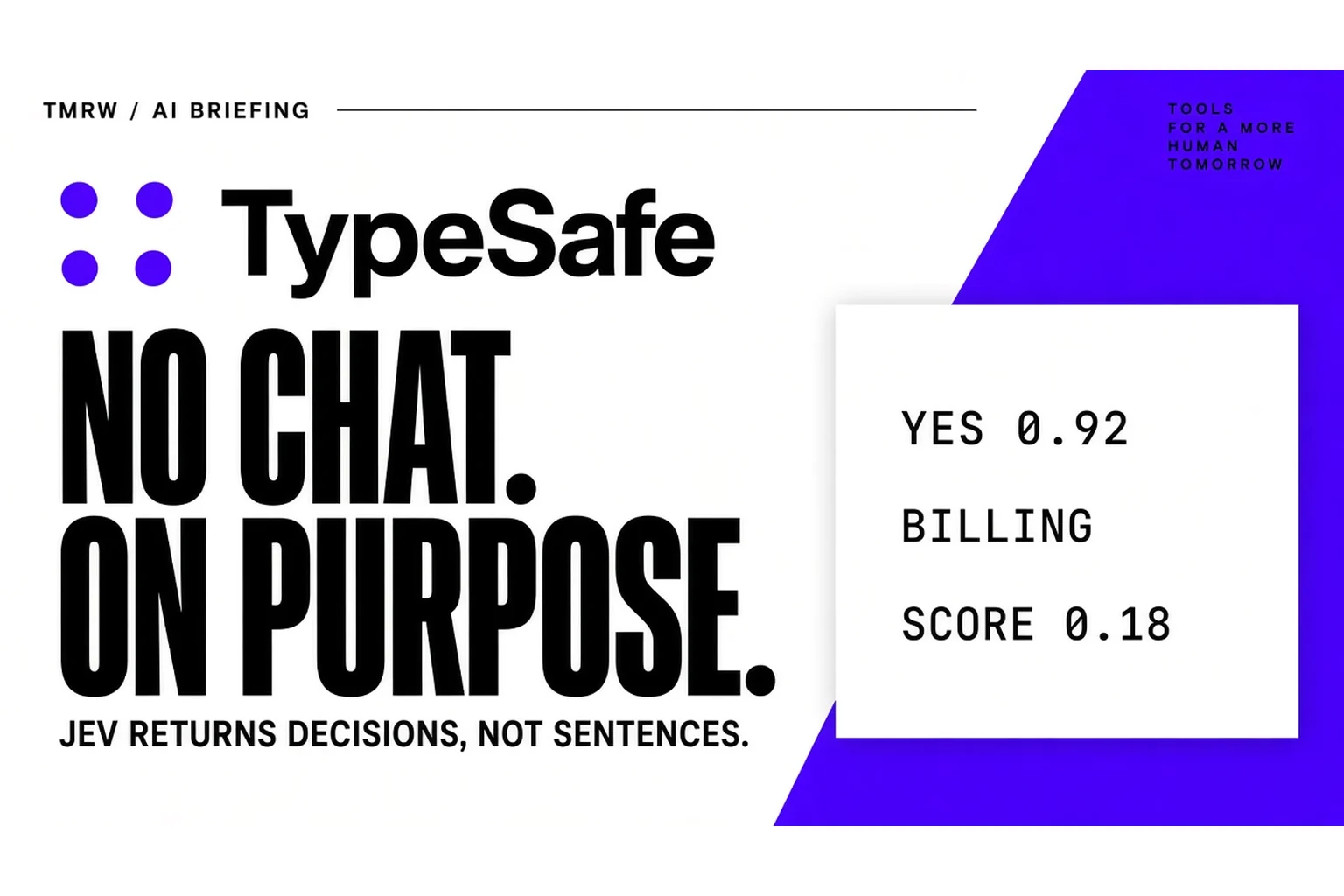
Cover: AI-generated editorial composition by TMRW. Based on TypeSafe’s 15 September announcement.
Diogo Almeida helped teach language models to talk. Reinforcement learning from human feedback — the method behind ChatGPT — is part of that work. On 15 September his startup TypeSafe shipped a model that gives that up on purpose. Jev does not write sentences. You send it a situation and a list of questions. It returns typed answers with probabilities, in 70 to 500 milliseconds.
Almeida’s question is blunt: models have been superhuman at chat for years, so where is the automation? His answer is that chat is the wrong interface for software. Software does not want a paragraph. It wants a value it can branch on.
What Jev actually returns
TypeSafe calls this a System One model, after Daniel Kahneman’s fast thinking. The name is a little too pleased with itself. The product is simpler. Three question types: yes or no, a choice from a fixed list, or a score. Every answer comes with a probability. For choices and scores, TypeSafe also returns a confidence measure. The schema is defined in advance, so the model cannot invent a fourth department or a tool that does not exist.
That is the “can’t hallucinate” claim, and it needs the fine print. Jev cannot emit an output outside the schema. It can still pick the wrong option inside it. A routing model that is 90 percent sure a billing ticket is a legal threat is still wrong 10 percent of the time. TypeSafe is honest about this in the announcement: higher confidence is supposed to mean higher accuracy. You still have to check that on your own data.
Price is the other shock. Input is $0.042 per million tokens, or $42 per billion. Output is free. TypeSafe compares that with Claude Fable 5.1 and says Jev is hundreds of times cheaper on its own workflow tests. The company also says it cannot prove the price is not subsidized. That sentence should stay attached to every glowing write-up.
Why this matters if you never write code
Most people reading this will never call an API. The reason to care is what happens inside the tools you already pay for. Support apps, invoice scanners, meeting notetakers, and “was this a jailbreak?” filters are full of hidden judgments: is this urgent, is this a refund, is this spam. Today those judgments often go to a chat model that then has to be parsed. Jev is built to skip the essay.
TechCrunch reported that Pranit Sharma, a software engineer at Vercel, replaced an OpenAI GPT-5.6 Luna safety classifier with Jev and saw results five to 18 times faster, with better accuracy. Vercel’s Guillermo Rauch posted a similar number. We have not reproduced that test. If it holds, the first place you will notice is not a new chatbot. It is a product that used to stall for three seconds and now does not.
Jev is in early access. There is a waitlist at typesafe.ai, and a path through Vercel’s AI Gateway. We have not been admitted to the API for this piece. The claims that are easy to falsify — speed, price, schema matching — are the ones TypeSafe invites you to try. The claim that it matches frontier models on “System One tasks” lives on TypeSafe’s own workflow evals, which use GPT-6 Astra and Fable 5.1 as the reference. That is a useful comparison. It is not an independent leaderboard.
What it will not do
Jev will not write your email, fix your spreadsheet, or replace ChatGPT. Almeida told the industry it is “more like a database than a coworker.” If your job is drafting, comparing, or explaining, you still need a model that talks. If your job is a stack of repeated yes-or-no decisions, a chat window is a slow, expensive way to get there.
The Doom demo is fun and slightly beside the point. Playing a game from structured state at ten queries a second proves latency. It does not prove that a hospital intake form or a school-office inbox should be automated at that speed. The interesting product test is boring: take fifty support tickets you already labeled by hand, run Jev, and see where confidence and truth diverge.
Named after Jevons, the economist who noticed that cheaper coal meant more coal burned, Jev is a bet that cheap decisions multiply. That can be good — fewer stalled workflows — or messy, if every app starts auto-routing your life with a 70 percent score. The schema keeps the model in its lane. Someone still has to decide whether the lane should exist.