Cover: AI-generated editorial composition by TMRW. Benchmark and cost figures are from Artificial Analysis; model details are from Xiaomi's release notes. Story first flagged by Superintelligence.
The day after xAI launched Grok 4.7 as its most capable model, Xiaomi released one that ties it on a widely watched composite benchmark and charges a fraction of the price. MiMo-V2.6 Pro came out on 22 September with its weights under the MIT license, which means anyone can download it, change it and use it commercially. For teams paying frontier prices for everyday agent work, it is worth a test. It is not a free lunch.
The numbers that matter
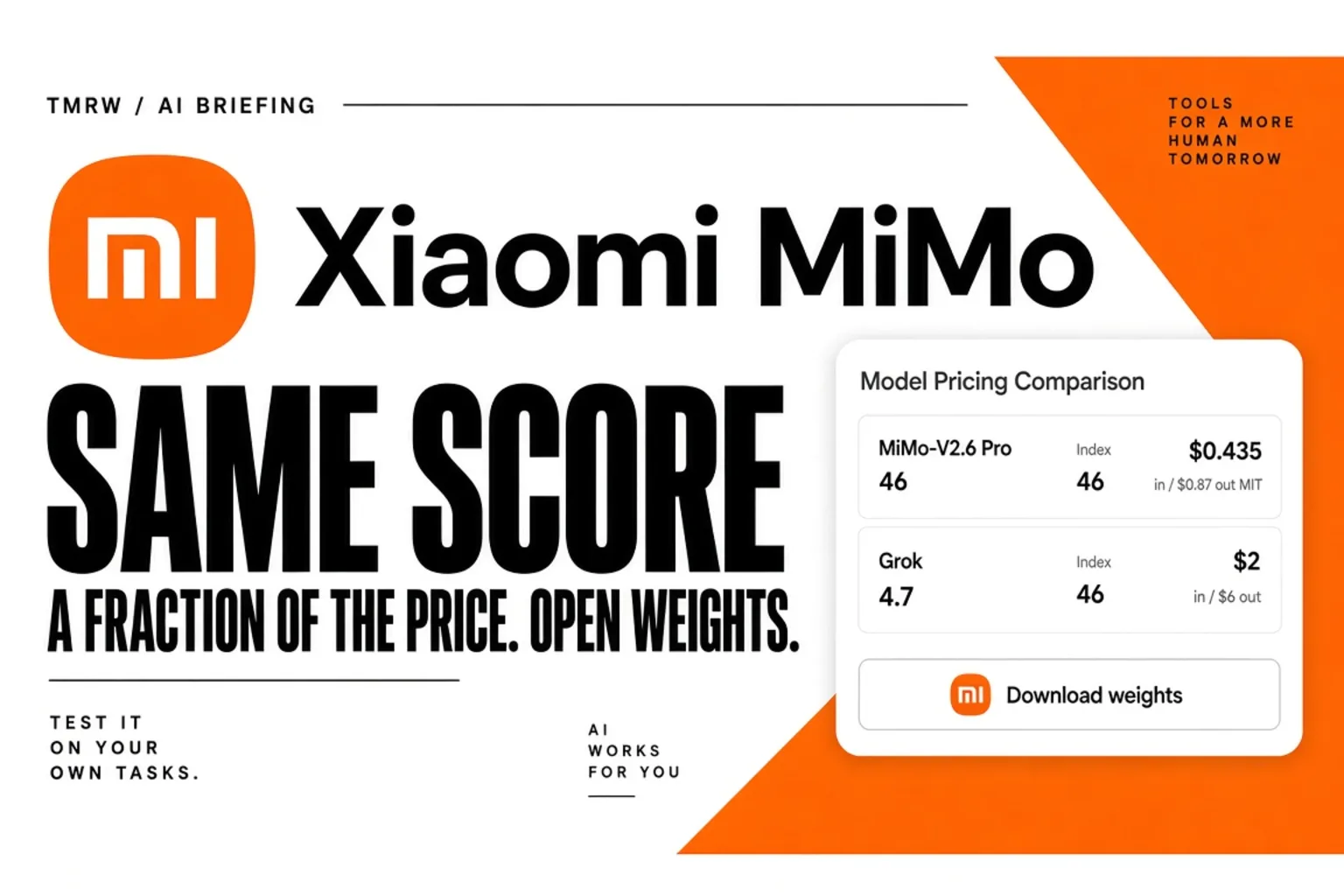
On the Artificial Analysis Intelligence Index, a composite of reasoning, coding and knowledge tests, MiMo-V2.6 Pro scores 46. So does Grok 4.7 at its highest reasoning setting. Xiaomi says that makes it the strongest open-weights model available, ahead of Kimi K3 and Qwen3.8 Max. It also concedes a gap remains behind the top closed models, Claude Fable 5.1 and GPT-6 Astra.
The price gap is the headline. Xiaomi's API charges $0.435 per million input tokens and $0.87 per million output tokens. Grok 4.7 starts at $2 and $6. Artificial Analysis says running its whole index cost about $207 on MiMo and about $4,967 on Grok 4.7.
The model is large: about a trillion parameters in total, with 42 billion active for each token. It reads text, images, speech and video, writes text, and holds a million tokens of context. A smaller Flash version shipped alongside it.
Where the tie breaks
A composite score hides trade-offs. On the same comparison page, Grok 4.7 leads on Artificial Analysis's Briefcase test of professional knowledge work. Artificial Analysis also calls MiMo "somewhat verbose," and that matters for cost: a model that writes twice as many tokens gives back some of its price advantage. Measure cost per finished task on your own workload, not cost per token.
What Xiaomi gave away
The release may matter more to researchers than to buyers. Xiaomi ran the final reinforcement-learning phase as a public six-day training run, with about 750,000 practice attempts across 30 steps, and says it cost about $2.62 million for Pro. On DeepSWE, a long-horizon software engineering benchmark the model did not train on, Pro rose from 58.4 to 72.6.
It then open-sourced the scaffolding along with the weights: more than 7,000 training environments covering software engineering, vulnerability reproduction, knowledge work and web design, plus the training framework and a small 9-billion-parameter model to practice on. Most labs publish results. Xiaomi published the gym.
Open weights, but where do they run?
MIT-licensed weights solve one problem: you are not locked to a single vendor or country. That matters for teams that cannot send sensitive data to a Chinese API, or any outside API. The weights are on Hugging Face, and the model is also available through OpenRouter.
Running it yourself is a different matter. GetDeploying estimates that even squeezed to 4-bit precision the model needs about 565 GB of GPU memory, roughly $10,080 a month for the cheapest rental that fits. At Xiaomi's API rates, that buys about 20 billion tokens a month. Unless you have that volume or a hard data requirement, rent the model rather than the hardware.
Who should try it
If you run high-volume agent tasks such as coding assistants, document processing or research loops, and they currently sit on a $2-to-$6 model, MiMo-V2.6 Pro is a cheap experiment. Replay a week of real tasks, count how many finish, and compare the bills.
If you need the best possible answer on hard problems, the closed frontier is still ahead, and Xiaomi says so itself. The bigger story is the trend. An open model now reaches the same composite score as a flagship released the day before, at a fraction of the price. That puts pressure on everyone's pricing, including labs that ship no open weights.