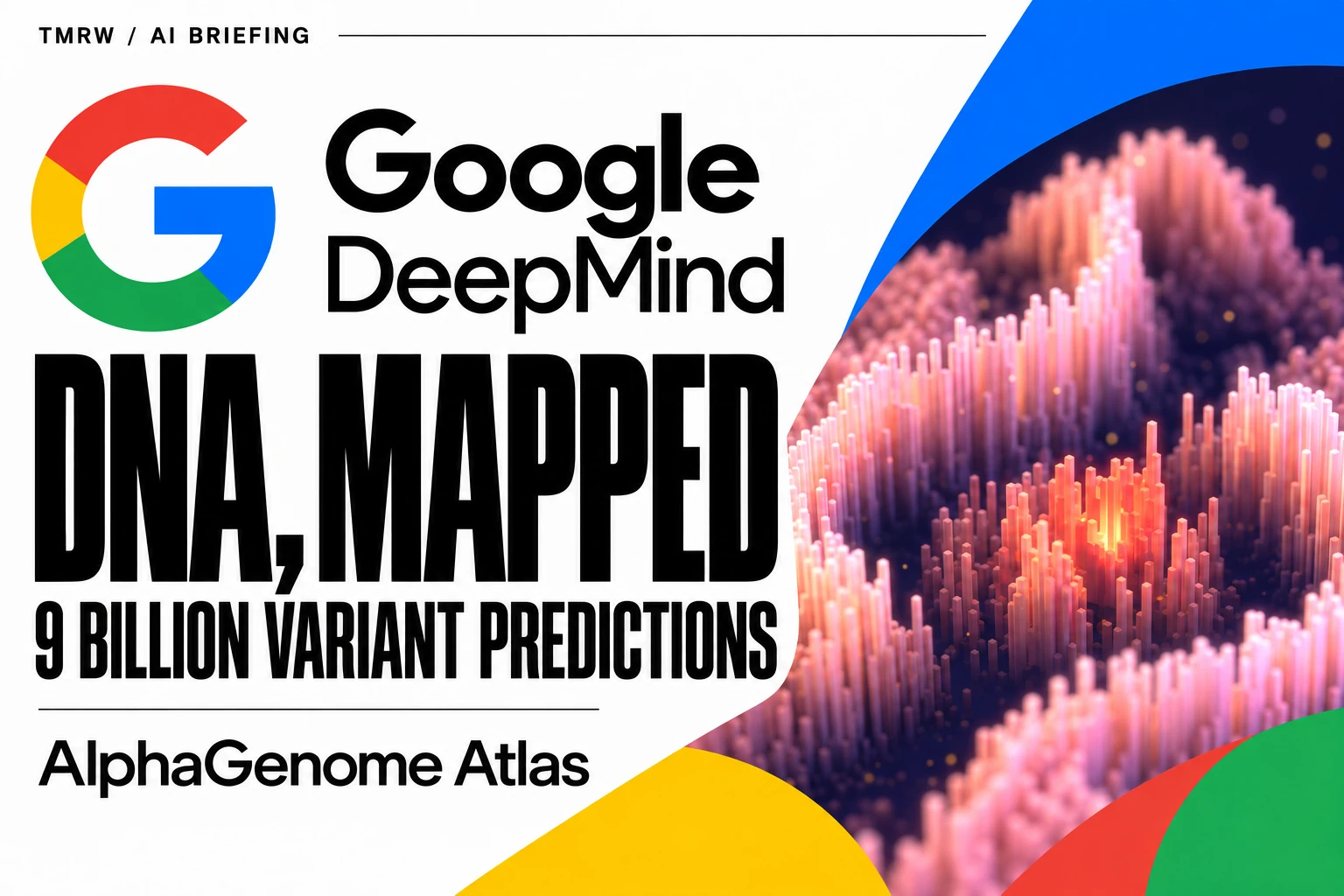
Cover: AI-generated editorial composition by TMRW, based on Google DeepMind’s launch artwork. Source material.
Google DeepMind launched AlphaGenome Atlas on September 8, turning a vast set of AI predictions about DNA into a searchable research resource. According to the launch announcement, the database contains precomputed predictions for nine billion possible single-letter changes in the human genome.
The scale makes the headline. The more useful idea is a change in workflow: researchers can look up a prediction instead of beginning every question with a fresh model run. That puts the emphasis on which biological questions to investigate next.
What the atlas contains
Google describes a one-petabyte resource and a combined measure called the AlphaGenome Variant Impact score, or AVI. It is intended to help prioritize variants across coding and non-coding regions. The company also describes a web portal that does not require coding.
In one example in the announcement, a Broad Institute team used the score to identify supporting evidence involving a DNM1 variant in rare-disease research. Another analysis used data from more than 54,000 UK Biobank participants. These are examples reported by Google; we have not independently reproduced their findings.
Prediction changes the queue
The distinction to keep in view is between selecting a promising candidate and establishing what that candidate does. A ranked list can make research more focused. Its first entry is still a hypothesis to examine, rather than a result that becomes true because it appears at the top.
Imagine a researcher faced with many candidate changes and a limited budget for follow-up work. The relevant question is whether the ranking improves the choice of what to investigate. A resource can be valuable without resolving the whole biological problem, provided it helps make that choice more informed and its limitations remain visible.
Our assessment is that this is the strongest way to read the announcement: as an attempt to reduce the work between having a list of variants and deciding which deserve attention. Calling it an explanation of every mutation would erase the distinction between a model's output and subsequent evidence.
The result worth watching
A useful follow-up would compare how researchers select candidates with and without the atlas. How often do highly ranked candidates hold up? Which kinds of cases remain difficult? Does easier access change who can use the resource, or merely reduce the steps for teams already equipped to evaluate its predictions?
Those questions also suggest what readers should look for in future coverage. A database size is a release milestone. Independent evaluations, clearly described failure cases and documented research decisions would tell us more about its practical value.
This is coverage of a research release, not advice for interpreting an individual's genetic results. We reviewed the announcement; we did not run an atlas analysis or validate a clinical use. For readers following AI in science, the launch is worth watching because it makes model output into reusable infrastructure. Its long-term value will depend on what researchers can establish with it.