
Clipto
Clipto
Freemium
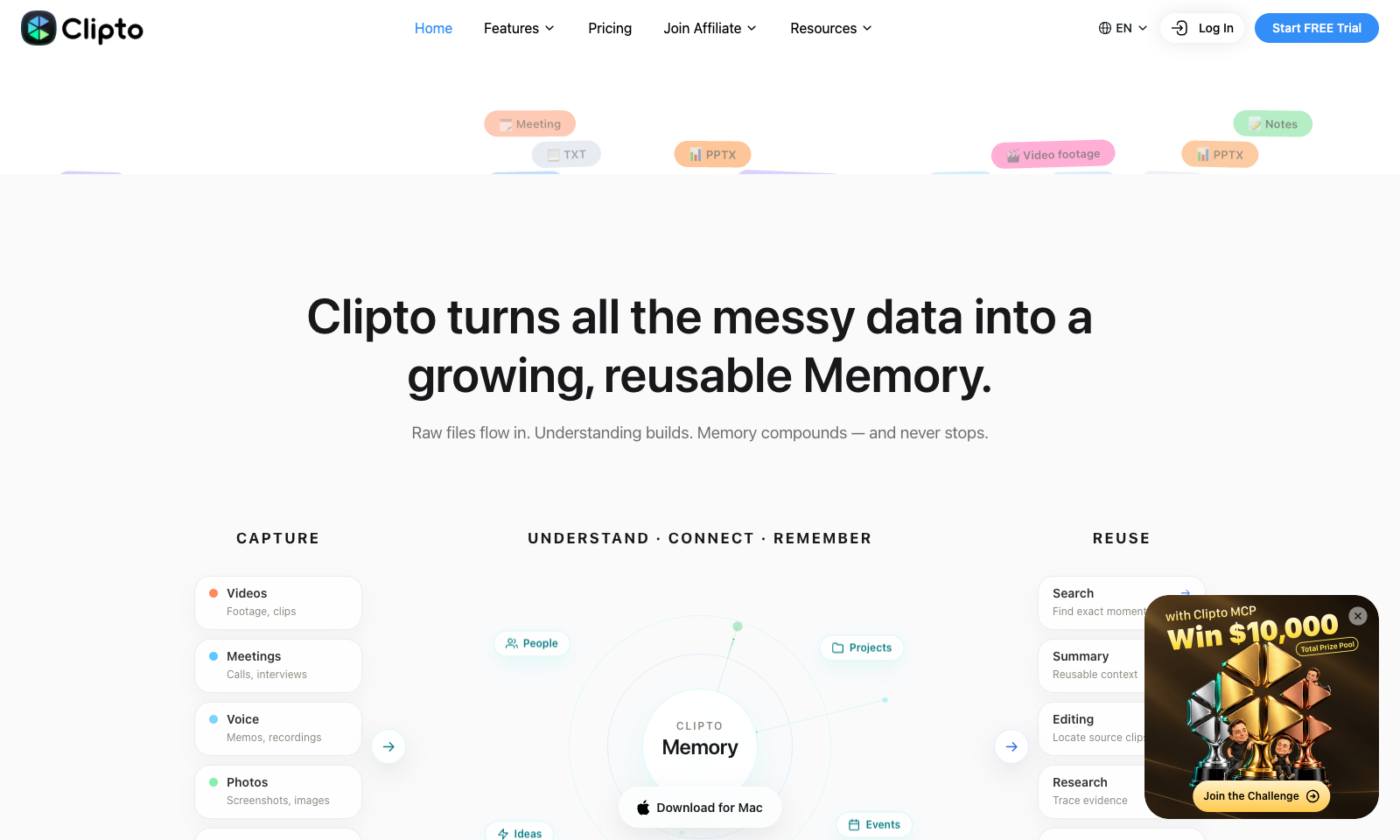
Clipto is local AI search for the media already on your machine. It indexes video, photos, meeting recordings, voice memos, and documents on-device, then lets you find a moment by what is on screen or what was said — not by filename. Results come back with a timestamp and a link into the original file, so "the shot where the car goes around the bend" returns a frame you can cut on, not a chatbot paragraph. The library is not just for you. Through an MCP server, Claude, ChatGPT, and Cursor can query it; Premiere Pro and DaVinci Resolve get plugins. You approve which folders are visible, and an agent gets structured hits back — not your whole disk, and not an upload of the source footage, which never leaves your machine by default.
Freemium
Keywords
local, video, mcp, transcription, editors
- Search the picture, not the filename: on-device tagging for scenes, people, dialogue. Jump to the frame.
- MCP into the editor you already use: Claude, ChatGPT, Cursor; Premiere Pro and DaVinci Resolve plugins.
- Source stays put: original media is not uploaded by default. Agents get structured hits, not your whole disk.
- Hardware is the catch: Apple silicon, 16 GB+ RAM, or a Windows box with 12 GB. This is not a browser toy.
TMRW VERDICT
A library, not another cloud to feed
by TMRW Team·Aug 31, 2026
The habit Clipto replaces is uploading footage to a chatbot to ask what is in it. That works for one clip. It is a terrible way to run an archive — uploads, context windows, lost timecodes, and your client's footage sitting on someone else's servers. A library has to live next to the files, work offline, and return a frame number. Clipto is built like it understands that, which puts it ahead of most of the "AI video" category on architecture alone.
The best thing about the product is that it states its costs out loud. It wants a serious machine. It wants a day for the first index. Its mobile apps are cloud, and it says so instead of blurring two products into one marketing sentence. On a page where every competitor promises magic, publishing your hardware floor is a genuine signal.
It is for editors and creators sitting on drives of footage — anyone who still opens folders named final_v7 to find a shot. Analysts who want searchable meeting memory qualify too, if they accept the RAM bill. Skip it if your team's footage already lives in Frame.io and that search works for you. Skip it on an 8 GB laptop. And do not treat the iPhone app as a trial of the desktop index, because it is not one.
We rate it 4 out of 5 for shipping the right architecture and being honest about its constraints. What we have not done is index a real archive and ask it a question that mattered to a deadline — that test is what stands between this and a 5. If the index is slow or the search misses, the rating drops. For now: if your library never left your disk, this is the most credible tool we have found for it.