
Opslane
Opslane
Freemium
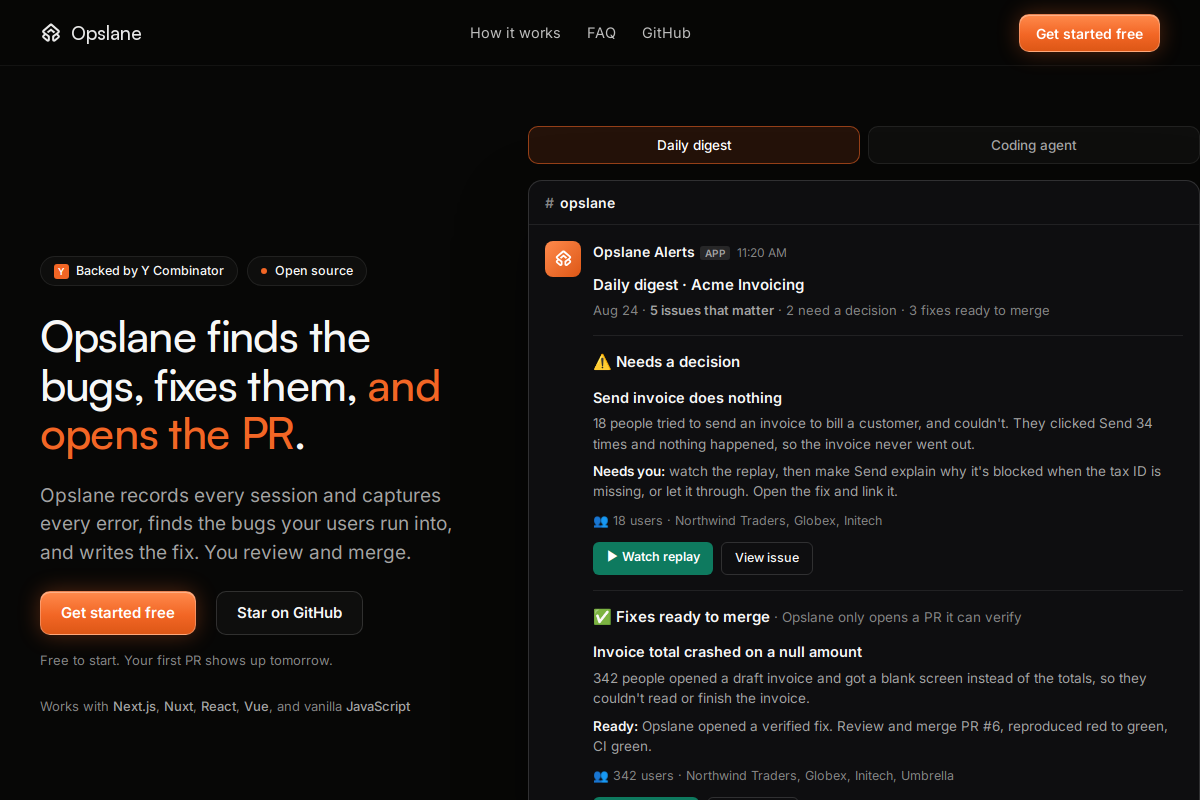
Opslane is an open-source error tracker whose output is not a dashboard — it is a fix. You install a browser SDK that captures errors, console logs, network requests, and session recordings (inputs masked by default). An AI agent then investigates the bugs your users actually hit, reproduces them in a sandbox, writes a fix, and opens a pull request only when it can verify the fix works. It never merges anything; you review the PR like any teammate's code. Two design decisions separate it from the error trackers it wants to replace. Issues are ranked by how many users hit them, and it watches session recordings for the bugs that never throw an exception — rage clicks, dead clicks, the form people abandon. A daily Slack digest sorts everything into fixes ready to merge, issues needing a product decision, and what broke; an MCP server and CLI let your coding agent drive fixes from the terminal. MIT-licensed, self-hosts from one Docker Compose file, and covers browser JavaScript apps with repositories on GitHub today.
Freemium
Keywords
error-tracking, session-replay, bug-fixing, open-source, mcp
- Verified fixes, not alerts: a PR opens only after the fix is reproduced and tested in a sandbox. Everything else lands as an investigation with a reason.
- Sees bugs that never throw: session recordings surface rage clicks, dead clicks, and abandoned forms — ranked by users affected.
- Agent-first by design: MCP server and CLI so Claude Code or Cursor reads the digest and fixes bugs from the terminal.
- Open source, self-hostable: MIT license, one Docker Compose file, Postgres and Minio only. Recordings masked by default, 30-day retention.
TMRW VERDICT
The error dashboard was never the deliverable
by TMRW Team·Aug 31, 2026
The founder's story is the product thesis: at Robinhood his team ran quarterly bug bashes against a Sentry backlog, fixed what they could, then selected all remaining bugs and marked them resolved. Every engineer who has done error-tracker bankruptcy will recognize it. The dashboards produce triage; the users were still hitting the bugs. Opslane's answer is to make the deliverable a verified pull request, and everything about the design follows from that.
What we can verify from the outside is unusually disciplined. It never merges — the PR waits on a human. Every run ends in an explicit state: verified fix, opt-in unverified draft, posted investigation, or a needs-human incident with a reason code. Inputs are masked before anyone, including the agent, sees a recording. And the whole thing self-hosts from one Docker Compose file, so the session data can stay on your infrastructure.
Skip it if your app is not browser JavaScript or your repos are not on GitHub — that is the entire supported surface today. Skip it if your team's objection to AI-written code is the review burden, because reviewing an agent's PRs is precisely the workflow. And if your Sentry triage genuinely works, this solves a problem you do not have.
There is no star rating here because we have not run it against production traffic. The claims that matter — how often the verification actually holds, how many PRs are mergeable, what the false-positive rate on "frustration" detection is — can only be tested with real users on a real app. The free tier and the Docker Compose file make that test cheap. Run it on something small before you point it at the money path.